Welcome back to The Workshop.
We’ve opened the Entryway. We’ve gone down into the Basement. We’ve looked around the Living Room. We’ve stepped into the Study and faced the Shouting Foe.
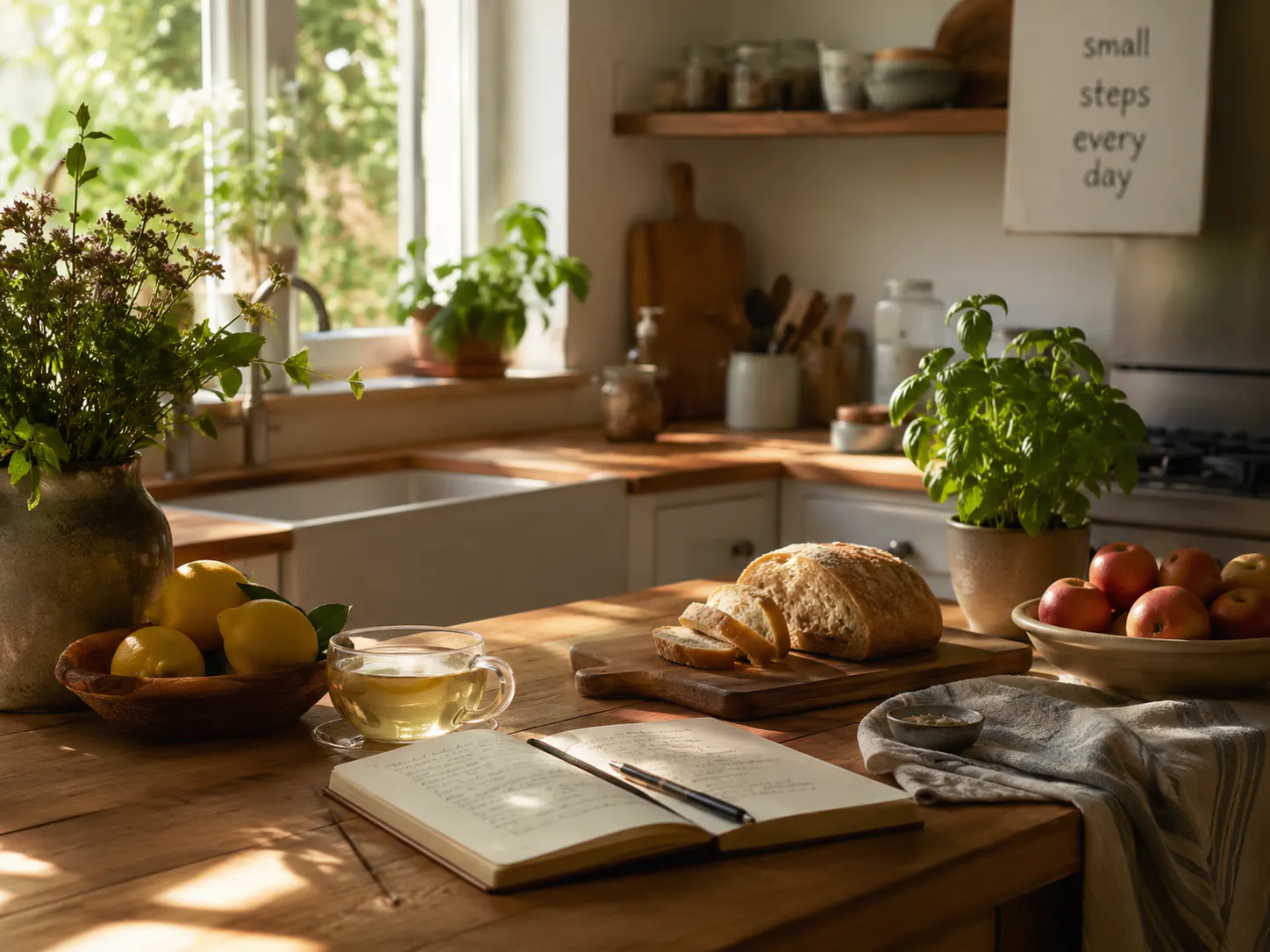
Now we enter the Kitchen.
In The Inner Remodel, the Kitchen is where change becomes practical.
Not glamorous.
Not dramatic.
Practical.
This is the room where we feed the house.
Body. Mind. Mood. Energy. Faith. Focus. The whole system.
And most of us don’t end up exhausted, stuck, resentful, numb, or disconnected because of one giant decision.
We get there because of what we keep feeding ourselves every day.
The food. The thoughts. The noise. The scrolling. The resentment. The hurry. The comparison. The old story we keep reheating like leftovers we don’t even like anymore.
The Kitchen is not only about what goes into your mouth.
It is about what goes into your life.
What are you consuming?
What are you repeating?
What are you reaching for when you’re tired?
What do you use to numb, distract, reward, punish, or avoid yourself?
Because eventually, everything we consume starts to cook inside us.
So let’s roll up our sleeves. No shame, no diet-culture nonsense, no “become a perfect person by Monday” pressure. Just honest tools for remodeling the Kitchen.
Step 1: Check What’s on the Counter
Before you change everything, notice what is already out in the open.
Most people think habits are hidden deep inside them, but many of our patterns are sitting right on the counter.
The phone by the bed. The nightly scroll. The argument we keep reheating. The third cup of coffee that is really a prayer for rescue. The schedule that leaves no room to breathe. The thought that says, “I’ll start when I feel ready.”
Tool: The Countertop Check
Take two minutes and ask yourself:
“What do I reach for when I am tired, overwhelmed, lonely, bored, or afraid?”
Don’t judge the answer. Just name it.
Food. Work. Scrolling. Control. Silence. Noise. Approval. Avoidance. A familiar old story.
Ah-ha moment: What you reach for is not random. It is usually an attempt to regulate something. The goal is not to shame the pattern. The goal is to understand what it has been trying to do for you.
Step 2: Open the Cabinets
The Kitchen has visible habits, but it also has stored ingredients.
These are the beliefs and inputs we keep using to make the same emotional meals.
Maybe the cabinet is stocked with:
“I’m behind.” “I have to earn rest.” “No one is coming.” “If I slow down, everything will fall apart.” “I’ll be happy when I finally fix myself.” “This is just who I am.”
And then we wonder why our days keep tasting the same.
Tool: The Ingredient List
Write down three thoughts, beliefs, or patterns you keep using as ingredients in your life.
Then ask:
Does this nourish me? Does this drain me? Does this keep recreating the same result?
Ah-ha moment: You cannot cook a new life with the same old ingredients and then act surprised when it tastes familiar.
Step 3: Stop Reheating the Old Story
Every Kitchen has leftovers.
Some are useful.
Some need to go.
In the inner house, leftovers are the old stories we keep pulling from the fridge because they are familiar, even if they no longer nourish us.
Stories like:
“I always mess things up.” “I’m too old.” “I’m too late.” “I’m not disciplined.” “I don’t have what it takes.” “People like me don’t get to have that.”
These stories may have started as protection. They may have helped us explain pain. They may have given us a strange kind of certainty when life felt chaotic.
But certainty is not the same as nourishment.
Tool: The Leftover Test
Pick one old story you keep reheating.
Now ask:
When did I first start believing this? What did this story protect me from? What does it cost me to keep serving it? What would be a more honest story now?
Not fake-positive.
Not “I am a limitless celestial billionaire” unless that’s your thing, in which case, enjoy the crystals.
Honest.
Instead of:
“I always fail.”
Try:
“I have failed before, and I am learning how to stay with myself while I try again.”
Instead of:
“I’m too late.”
Try:
“I am grieving the time I lost, but I am still allowed to begin.”
Instead of:
“This is just who I am.”
Try:
“This is a pattern I practiced for a long time, and now I can practice something else.”
Ah-ha moment: You don’t have to believe the new story perfectly. You just have to stop feeding the old one like it owns the house.
Step 4: Make One Small Meal
This is where people get in trouble.
They notice what needs to change, and immediately try to remodel the entire Kitchen in one afternoon.
New diet. New routine. New schedule. New journal. New gym plan. New morning practice. New identity. New personality. New monk robe, apparently.
And then, three days later, they are face down in the old leftovers wondering what happened.
The Kitchen is not asking for a dramatic overhaul.
It is asking for one honest meal.
One small practice that feeds the life you say you want.
Tool: The One-Meal Practice
Choose one small thing this week that nourishes the house.
Not ten things.
One.
A glass of water before coffee. A ten-minute walk. A real breakfast. A prayer before the day starts. One less scroll before bed. A kinder sentence when the Shouting Foe starts yelling inside your head. A boundary with something that keeps draining you. A moment of silence before reacting.
Small is not weak.
Small is repeatable.
And repeatable is where change begins.
Ah-ha moment: Your life is shaped less by the promises you make in emotional lightning storms and more by the small choices you repeat when nobody is clapping.
Final Thought
The Kitchen is where we learn that change is not only an idea.
It is a practice.
You can understand the Basement. You can notice the borrowed furniture in the Living Room. You can take the red pen away from the Shouting Foe in the Study.
But eventually, you have to ask:
What am I feeding every day? Because your life is not shaped only by what you believe. It is shaped by what you keep consuming, repeating, rehearsing, and practicing.
The Kitchen reminds us that nourishment is not punishment.
Discipline is not self-hatred.
A habit is not just a task.
It is a vote for the life you are building.
You do not have to become perfect. Please don’t. Perfection ruins the meal.
Just choose one thing that feeds the version of you you’re trying to become.
One honest choice.
One cleaner ingredient.
One better sentence.
One less reheated story.
One small meal at a time.
Next time in The Workshop: the Bathroom — where we learn what needs to be released, rinsed off, and finally allowed to leave the body.
Until then: What is one thing you’ve been feeding that may no longer belong on the plate? Drop it in the comments, or write it down for yourself.
For the full blueprint, grab The Inner Remodel at innerremodel.com.
Let’s keep remodeling — one honest room at a time.