The Inner Workshop: Remodeling Your Bathroom – Releasing What Was Never Meant to Stay
September 18, 2026
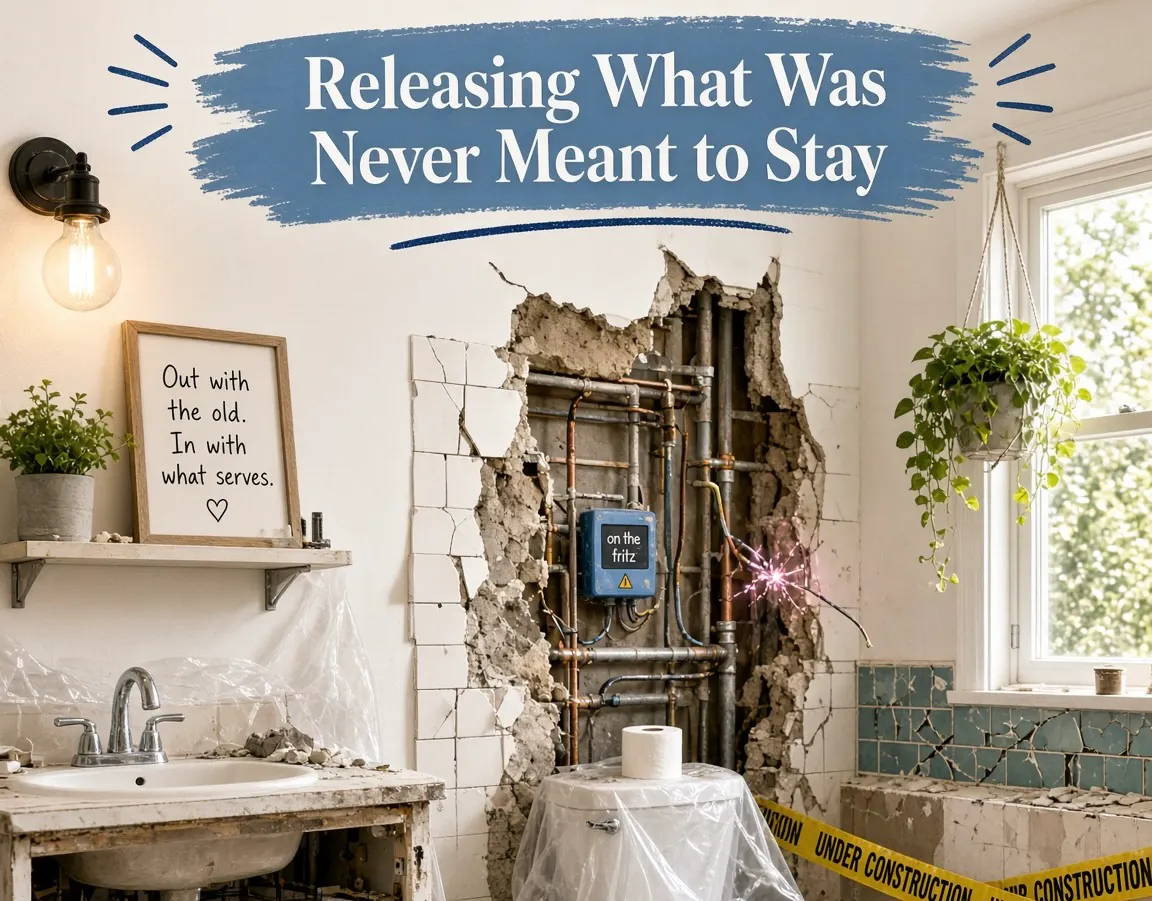
Welcome back to The Workshop.
We’ve opened the Entryway. We’ve gone down into the Basement. We’ve looked around the Living Room. We’ve stepped into the Study and faced the Shouting Foe. We’ve entered the Kitchen and asked what we are feeding every day.
Now we enter the Bathroom.
In The Inner Remodel, the Bathroom is the room of release.
Not punishment.
Not shame.
Not standing in front of the mirror cataloging every flaw like the inner critic got promoted to building inspector.
Release.
This is the room where the house lets go of what it no longer needs.
The body knows this.
The body is wise that way.
It understands digestion. Sweat. Tears. Breath. Elimination. Rinsing off the day. Washing what has clung too long to the skin.
The body does not ask permission to release. It does not hold a committee meeting with your trauma, your ego, and your childhood wounds to decide whether the old waste has earned the right to leave.
It just knows:
This cannot stay.
But emotionally?
We are not always so wise.
We hold on.
We carry old shame like it is proof of maturity. We carry guilt like it is a sacred duty. We carry resentment like it is keeping the score honest. We carry grief without giving it anywhere to move. We carry other people’s judgments as if they were handed to us by God with a notarized signature.
And then we wonder why we feel heavy.
The Bathroom asks one simple question:
What am I still holding that my life has been begging me to release?
So let’s roll up our sleeves.
Actually, maybe wash our hands first.
No shame, no self-punishment, no spiritual pressure to “just let it go” before the body is ready. Just honest tools for remodeling the Bathroom.
Step 1: Notice What You’re Still Carrying
Before you release anything, you have to notice what is still being carried.
This sounds obvious.
It is not.
Many of us are so used to carrying emotional weight that we stop recognizing it as weight. It becomes posture. Personality. Humor. Sarcasm. Busyness. Tension in the jaw. Tightness in the gut. A story we tell ourselves so often it starts sounding like our name.
“I’m just anxious.” “I’m just intense.” “I’m just bad at relaxing.” “I’m just the responsible one.” “I’m just not good at letting things go.”
Maybe.
Or maybe you have been carrying something so long that your body started calling it normal.
Tool: The Weight Check
Take 2–3 minutes and ask yourself:
“What am I still carrying that makes my life heavier than it needs to be?”
Don’t force the answer.
Let it surface.
A regret. A betrayal. A grudge. A secret. An old mistake. A version of yourself you still punish. A conversation you replay. A responsibility that was never yours. A shame that should have never been handed to you.
Write down whatever comes up.
Ah-ha moment: You cannot release what you keep pretending is not heavy.
Step 2: Separate Responsibility from Shame
This is important.
The Bathroom is not where we pretend nothing happened.
Release does not mean denial.
Release does not mean, “It’s fine.”
Release does not mean bypassing pain with a scented candle and a quote about positive vibes.
Some things do require responsibility.
If you hurt someone, accountability matters.
If you made a mistake, repair may be needed.
If you avoided something, honesty may be required.
But shame is different.
Responsibility says:
“I did something that needs attention.”
Shame says:
“I am something that should be hidden.”
Responsibility can lead to repair.
Shame leads to rot.
Tool: The Clean Water Question
Pick one thing you are carrying.
Now ask:
Is there an action I need to take here? Is there a repair I need to attempt? Is there something I need to learn? Is there anything useful left in this guilt?
Then ask:
Or am I just punishing myself because punishment feels like control?
If there is an honest action to take, take the next small step.
Apologize. Tell the truth. Make the call. Change the behavior. Set the boundary. Stop pretending.
But if there is no action left, if all that remains is the same old shame circling the drain, then maybe it is time to stop calling self-punishment growth.
Ah-ha moment: Accountability cleans. Shame stains.
Step 3: Let the Body Participate
The mind loves to discuss release.
The body actually knows how to do it.
That is why we cry. Sweat. Shake. Sigh. Exhale. Sleep. Walk. Pray. Breathe. Wash our faces and somehow feel one percent more human.
Not everything can be thought into freedom.
Some things need to move.
The Bathroom reminds us that release is not only a mental decision.
It is a physical event.
Tool: The Rinse Practice
Choose one small physical ritual this week.
Keep it simple.
Take a slow shower and imagine the day leaving your body. Wash your hands after writing down something you are ready to release. Exhale slowly ten times and let each breath carry one ounce of tension out of the house. Go for a walk and let your feet process what your mind cannot solve. Cry without turning it into a performance review.
As you do it, say silently:
“This does not have to stay in me.”
Not because you can force it out.
But because you are reminding the house that release is allowed.
Ah-ha moment: Sometimes the body releases what the mind is still trying to explain.
Step 4: Stop Reinstalling What You Released
This is where the Bathroom gets annoying.
Because sometimes we let something go…
and then go pick it back up.
We rinse off the shame, then put the old shirt back on. We forgive someone in the morning, then rehearse the courtroom speech by dinner. We decide we are done carrying an old identity, then spend the night scrolling through evidence that proves we still are.
This does not mean you failed.
It means the pattern is familiar.
The nervous system often returns to what it knows, even when what it knows is painful.
Tool: The Do Not Reinstall List
Write down one thing you are practicing releasing.
Then write:
“I am no longer reinstalling this by…”
Finish the sentence three ways.
For example:
I am no longer reinstalling this by replaying the same argument every night. I am no longer reinstalling this by checking their page. I am no longer reinstalling this by calling myself stupid for something I understand now. I am no longer reinstalling this by confusing guilt with loyalty. I am no longer reinstalling this by using one mistake as proof of my identity.
Ah-ha moment: Letting go is not always one dramatic release. Sometimes it is the daily choice not to pick the old weight back up.
Final Thought
The Bathroom is not glamorous.
No one brags about remodeling the emotional plumbing.
But if the Bathroom is not working, the whole house suffers.
Because a house needs a place to release.
So does a human being.
You were never meant to keep everything.
Every old shame. Every regret. Every betrayal. Every inherited fear. Every cruel sentence someone said when they were careless with your heart. Every version of you that was doing the best it could with the tools it had.
Some things need to be learned from.
Some things need to be grieved.
Some things need to be repaired.
And some things simply need to leave.
Not because they did not matter.
Because they did.
And now they are done being carried.
The Bathroom is where we stop confusing holding on with healing.
It is where we let clean water tell the truth:
This can move through me.
This can leave my body.
This does not have to become my name.
Next time in The Workshop: the Bedroom — where we stop performing, learn the difference between collapse and rest, and ask where we need to soften, surrender, or let ourselves be held.
Until then: What is one thing you are still carrying that your life may be asking you to release? Drop it in the comments, or write it down for yourself.
For the full blueprint, grab The Inner Remodel at innerremodel.com.
Let’s keep remodeling — one honest room at a time.